EU GMP vs US FDA cGMP: What Global Pharma Expansion Teams Must Decide Early
Compare EU GMP and US FDA cGMP requirements for QP release, validation, facility design, and inspections, and build an inspection-ready global compliance strategy.
September 08, 2026
A pharmaceutical facility does not fail global GMP expectations because the engineering team forgot that Europe has a Qualified Person or that the FDA uses 21 CFR.
It fails when market-specific regulatory expectations are discovered after facility, process, utility, and quality-system decisions have already been frozen.
That distinction matters.
For manufacturers planning access to Europe and the United States, particularly organizations expanding from the GCC, Asia, and other emerging manufacturing markets, the real question is not whether EU GMP or US FDA cGMP is “stricter.” The question is whether the same facility and pharmaceutical quality system can generate defensible evidence of control under both regulatory frameworks.
Both systems focus on product quality, process control, validated operations, and effective quality oversight. But their legal architecture, batch-release responsibilities, validation language, and inspection mechanisms differ. EU GMP is established principally through EudraLex Volume 4, while US pharmaceutical cGMP requirements include 21 CFR Parts 210 and 211.
For leadership teams, those differences should influence decisions before design freeze, not during inspection remediation.
EU GMP vs US GMP: What Is the Real Difference?
The most dangerous simplification is to treat EU GMP as highly prescriptive and US GMP as simply “flexible.”
The reality is more nuanced.
The FDA's cGMP framework allows manufacturers to determine appropriate systems and controls within regulatory requirements, supported by guidance on modern pharmaceutical quality systems and risk management. EU GMP also explicitly incorporates risk-based thinking and lifecycle concepts through its chapters, annexes, and alignment with ICH principles.
The practical differences therefore lie less in whether manufacturers must demonstrate control and more in how responsibility, evidence and regulatory expectations are structured.
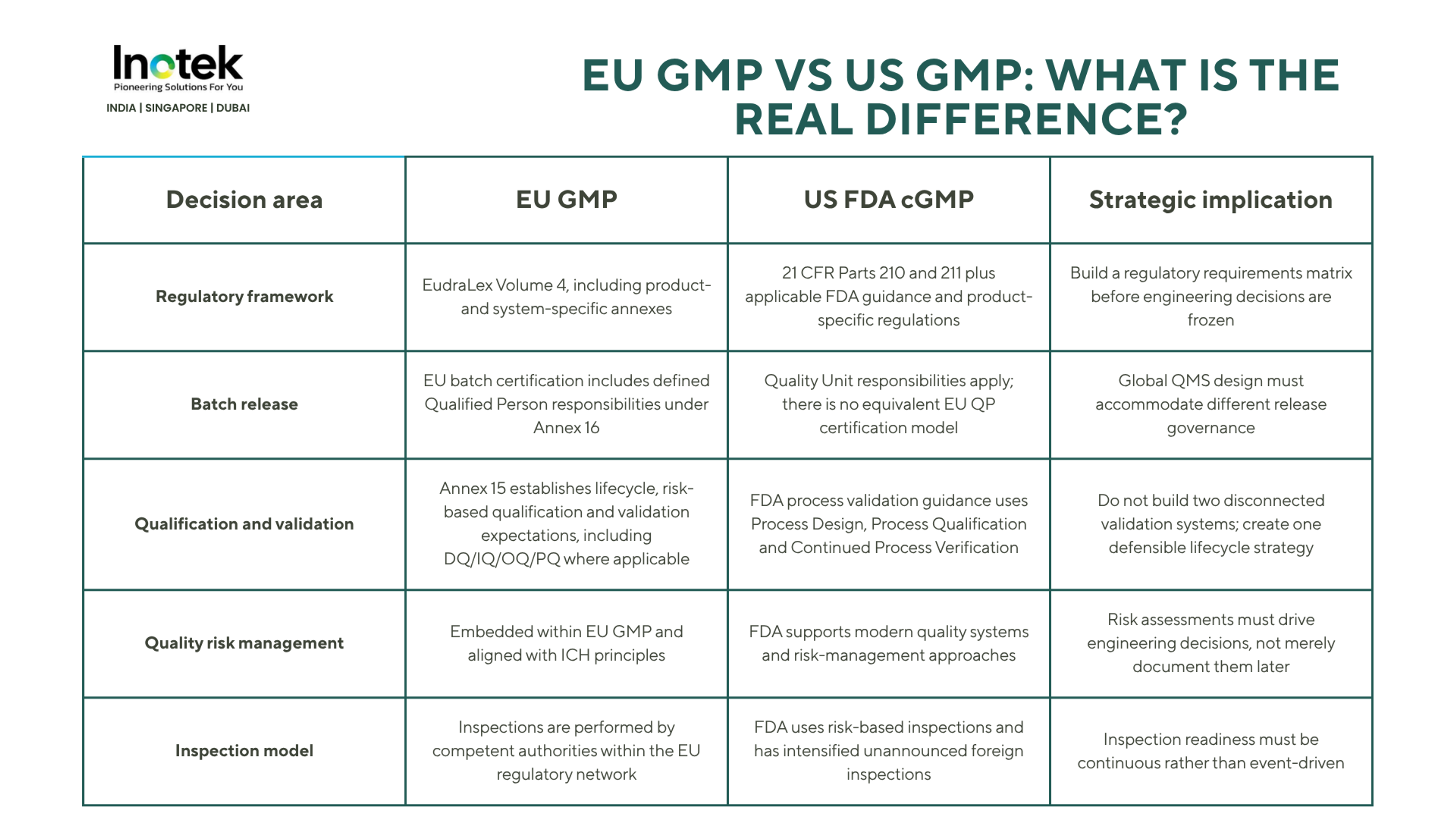
EU Annex 16 makes this distinction particularly important: the QP certifying a finished medicinal-product batch must ensure the batch was manufactured and checked in accordance with GMP, applicable law, and the marketing authorization.
You can't solve that responsibility by adding another SOP shortly before an EU inspection.
It affects how the underlying system is designed.
The Validation Difference Is Often Misunderstood
Many dual-market projects make a false comparison:
EU = DQ/IQ/OQ/PQ. US = lifecycle validation.
That is too simplistic to be useful.
EU GMP Annex 15 addresses qualification and validation within a lifecycle and risk-based framework. FDA's process validation guidance similarly treats validation as an ongoing lifecycle, encompassing process design, process qualification and continued verification.
The leadership issue, then, is not which acronym to adopt.
It is whether the organization can maintain a coherent chain from:
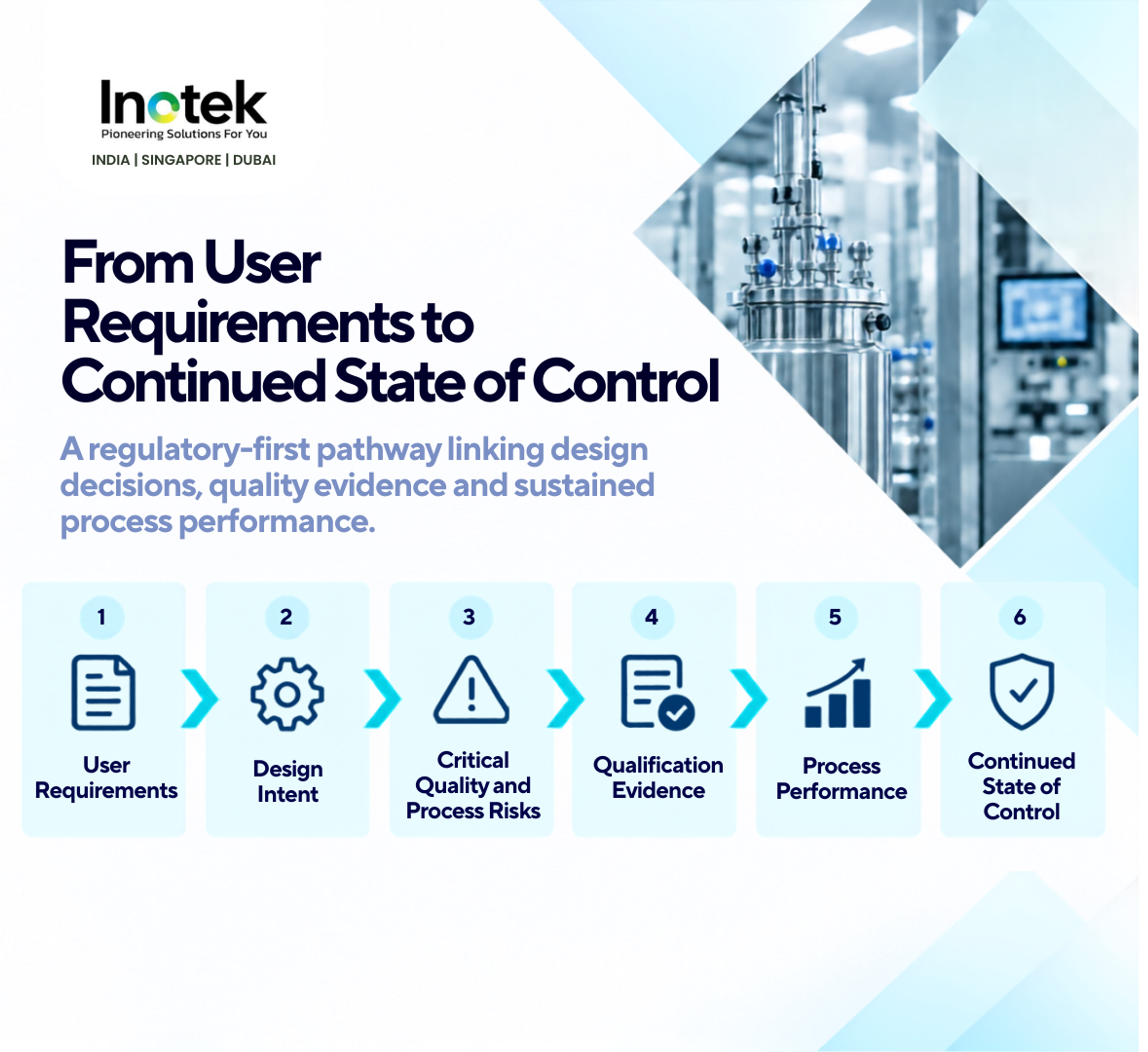
If those elements are fragmented across engineering documents, vendor packages, validation protocols and QA procedures, the facility may appear technically complete while remaining difficult to defend during inspection.
That is where global projects accumulate regulatory debt.
Dual-Market Compliance Starts With Facility Decisions
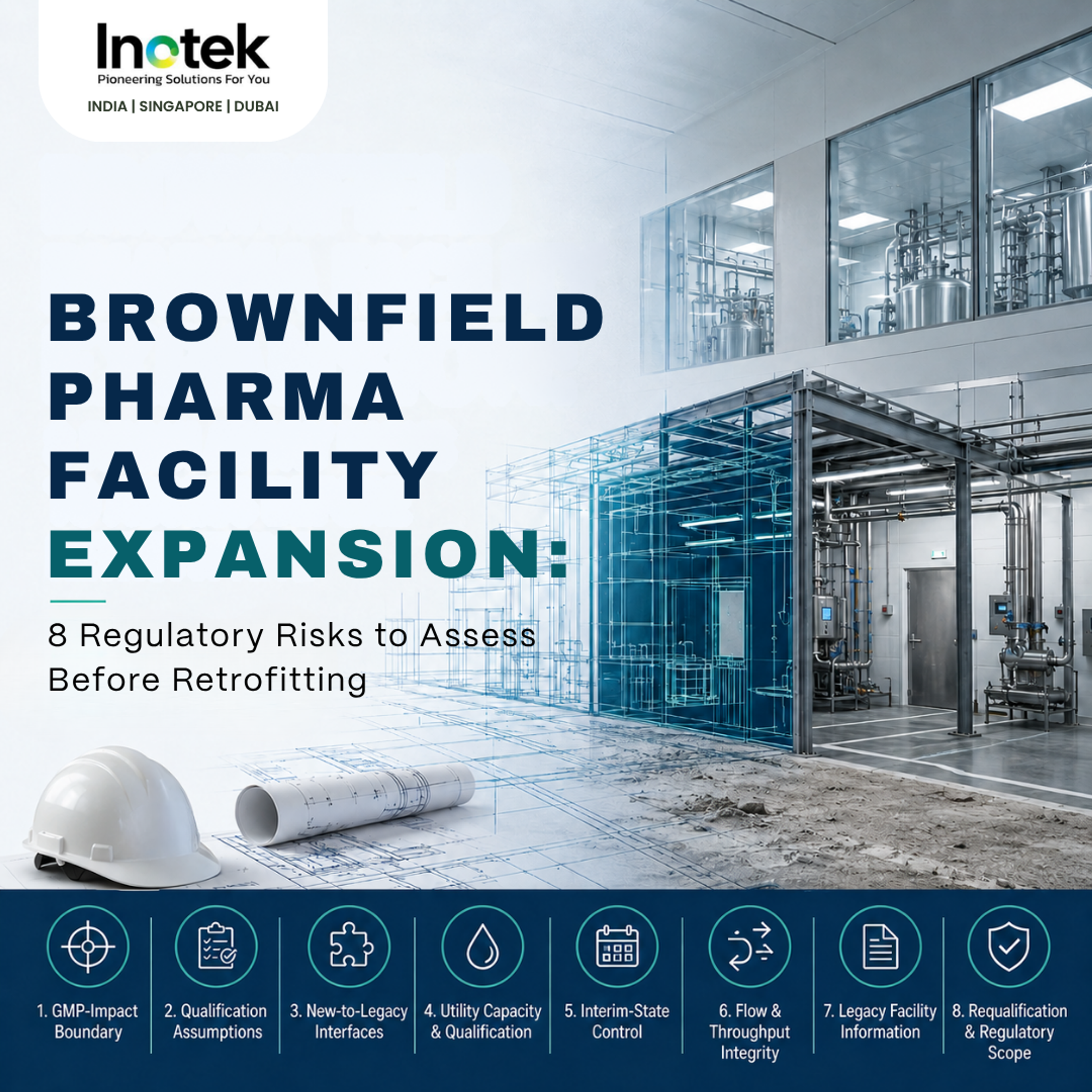
A GMP-compliant facility is not created by adding validation after construction. Regulatory exposure is often embedded much earlier.
Consider a seemingly straightforward layout compromise introduced to reduce footprint. It may create a personnel-flow conflict.
A shared corridor may subsequently require procedural controls.
An HVAC zoning decision may complicate containment or environmental control.
A utility concept may technically meet capacity requirements while making monitoring, maintenance, or qualification unnecessarily difficult.
Each decision may appear acceptable in isolation. During inspection, however, regulators examine whether the overall system demonstrates control.
For dual EU-US readiness, engineering teams should therefore ask a different question:
Can we explain why this design decision is scientifically justified, risk-assessed, operationally controllable, and supported by evidence throughout the lifecycle?
That is a stronger test than asking whether a drawing appears to comply with a clause.
QP Release Changes the EU Compliance Architecture
For companies manufacturing outside the EU, the Qualified Person requirement is not simply an administrative difference.
Annex 16 places defined responsibilities on the QP certifying the finished batch, including assurance over manufacturing, testing, supply-chain information, relevant audits, validated status and compliance with the marketing authorization.
This affects decisions on supplier oversight, outsourced activities, technical agreements, testing strategy, deviations, documentation architecture, and information availability.
In other words, EU market entry must be designed around the evidence the QP will eventually need to rely upon.
Waiting until regulatory submission or pre-inspection preparation to address that information chain is a costly way to discover that the underlying systems were never designed to support it.
US FDA Readiness Increasingly Means Readiness Without Notice
The same principle applies to the US market.
FDA announced an expansion of unannounced inspections at foreign manufacturing facilities in May 2025 and has continued intensifying that approach. The agency reported in 2026 that the proportion of unannounced inspections conducted by its India foreign office had increased substantially compared with FY2025.
That changes the value of inspection preparation.
A facility that becomes inspection-ready only after a notification is not operating with a sufficiently mature state of control.
For senior management, the relevant question becomes:
Would the facility, QMS, and underlying engineering rationale remain defensible if the regulator arrived before the organization had time to “prepare” the site?
That is the standard global expansion programs should design toward.
Does the EU-US MRA Make Dual Compliance Easier?
Yes, but not in the way many project teams assume.
The EU-US Mutual Recognition Agreement enables regulatory authorities to rely on certain inspection activities performed by their counterparts and is fully operational for most human medicines within its scope. It can reduce unnecessary duplication of inspections and, in applicable circumstances, EU re-testing requirements.
It does not turn EU GMP and US cGMP into a single regulatory framework.
Manufacturers still need systems that meet applicable legal, quality, batch-release, and market-authorization requirements.
Mutual recognition reduces duplication between regulators. It does not remove the manufacturer's obligation to make defensible compliance decisions.
“EU GMP Certification” Is Not a Badge You Design a Plant Around
The phrase EU GMP certification is widely used commercially, but leadership teams should understand what sits behind it.
EU competent authorities can issue a Certificate of GMP Compliance of a Manufacturer following inspection. EudraGMDP records show that the certificate reflects the compliance status of the inspected manufacturing site at the time of that inspection.
The objective therefore should not be to “design for a certificate.”
It should be to establish a facility and pharmaceutical quality system whose regulatory rationale remains defensible when inspected.
The certificate is an outcome of that capability, not a substitute for it.
The Global GMP Strategy: Harmonize the Core, Design for the Differences
Global manufacturers do not need duplicate facilities or competing quality systems for every market.
They need a common compliance architecture with deliberately identified market-specific requirements.
That means establishing the intended regulatory markets early, defining critical regulatory requirements before conceptual and basic design are locked, aligning facility and QMS decisions, building a coherent validation lifecycle, and maintaining documentation that explains not only what was implemented but why the decision remains justified.
For CXOs, QA Heads and Engineering Leaders, this is where global expansion becomes either predictable or expensive.
The cost of early regulatory interpretation is small compared with redesigning a facility whose fundamental GMP assumptions cannot withstand inspection.
Why Independent Regulatory-First Consulting Matters
Execution-led project organizations naturally operate under pressure from capital budgets, procurement packages, construction schedules and vendor boundaries.
Those constraints are legitimate, but they should not determine regulatory interpretation.
Inotek operates differently.
As a pure consulting organization, Inotek does not undertake construction, equipment supply, HVAC supply, or EPC execution. Its role is to provide independent regulatory, engineering, QMS and validation intelligence before irreversible decisions are made.
That separation matters when a project needs someone to challenge a layout, validation strategy, contamination-control assumption or documentation model without being influenced by the cost of executing the recommendation.
The objective is not more engineering.
It is better to make regulatory decisions before engineering becomes expensive to change.
If your organization is planning EU or US market access, a brownfield expansion, or a new GMP facility, engage Inotek before design assumptions become project constraints.
FAQs
What is the main difference between EU GMP and US FDA cGMP?
Both frameworks require controlled manufacturing and effective pharmaceutical quality systems. Important differences include EU Qualified Person batch certification, differences in regulatory architecture and terminology, and how qualification, validation, and inspection responsibilities are expressed. The best strategy is to design one robust compliance system that explicitly accounts for both frameworks.
Does EU GMP require DQ, IQ, OQ and PQ while the FDA does not?
That comparison is misleading. EU Annex 15 includes qualification stages such as DQ, IQ, OQ and PQ where applicable, while also applying lifecycle and risk-based principles. FDA process validation guidance uses a lifecycle model covering process design, process qualification and continued process verification. The systems should be integrated rather than treated as competing approaches.
Is there an EU GMP certification for pharmaceutical facilities?
Following inspection, an EU competent authority may issue a Certificate of GMP Compliance of a Manufacturer, with information recorded in EudraGMDP. It reflects the inspected site's GMP compliance status; it should not be treated as a generic certification badge independent of the site's authorized activities and regulatory context.
Does the FDA issue a GMP certificate?
US FDA oversight is based on compliance with applicable cGMP regulations and inspectional findings rather than an EU-style GMP compliance certificate. Pharmaceutical cGMP requirements include 21 CFR Parts 210 and 211, with additional requirements depending on product type.
Can one pharmaceutical facility comply with both EU GMP and US FDA requirements?
Yes. The critical issue is not creating two facilities or two disconnected QMS structures, but identifying regulatory differences early and ensuring facility design, quality governance, validation, documentation, and lifecycle controls provide defensible evidence for both markets.
More blogs
Related reading
8 Regulatory Decisions Before CGT Engineering Freeze
Dead Legs in Pharma Utilities: Why CAPA Cannot Fix Poor Design