How to Build a GMP-Compliant Pharma Manufacturing Facility in Uzbekistan
December 24, 2025
Building GMP-compliant pharmaceutical manufacturing facility for Uzbekistan’s Expanding Pharma Market
Uzbekistan’s pharmaceutical sector is expanding rapidly, driven by localization mandates, export ambitions, and increased foreign investment. It's in an accelerated growth phase. By September 2025, the wholesale market reached $2.14 billion annually, up from $0.89 billion in 2018, reflecting an average growth rate of over 13.4%. This rapid expansion is driving manufacturers toward localization, capacity creation, and export readiness simultaneously. For manufacturers entering or scaling into this market, building a GMP-compliant pharmaceutical manufacturing facility is no longer optional. It is the foundation for regulatory trust, product quality, and access to international markets.
As Uzbekistan accelerates localization, attracts foreign investment, and positions itself as an export-ready pharma hub, the execution of GMP-compliant facilities has become a strategic necessity. This article breaks down what GMP compliance means in practice, where projects typically fail, and how manufacturers can design, build, and validate facilities that are inspection-ready from Day 1.
Why GMP Compliance Is Non-Negotiable in Uzbekistan’s Pharma Expansion
GMP compliance determines whether a facility can supply regulated domestic markets and export to WHO-aligned regions. In Uzbekistan, GMP is a business enabler. Facilities that fall short face delayed approvals, restricted exports, and repeated audit observations.
What GMP Compliance Means in Facility Execution
In execution terms, GMP is about translating written requirements into physical controls and verifiable systems, not relying on policy documents alone.
Key execution implications include:
- Facility layouts must enforce unidirectional material and personnel flow, with clear segregation between clean, less-clean, and non-classified areas to minimize cross-contamination risks
- Utilities such as HVAC, purified water, WFI, and clean steam must be designed as GMP-critical systems, with defined operating ranges, alarms, and monitoring points built into engineering deliverables from the outset.
- Validation deliverables (URS, DQ, IQ, OQ, PQ) are execution checkpoints, not post-construction paperwork, confirming the facility performs as intended under routine operating conditions.
Facility Systems That Drive Audit Outcomes
Audit outcomes are largely determined by the quality of the engineering and integration of core facility systems.
Critical drivers include:
- HVAC zoning and pressure cascades must demonstrate clear contamination control logic, supported by documented air-change rates, filtration stages, and recovery times
- Cleanroom classification must align with process risk, with finishes, joints, and penetrations designed to support effective cleaning and inspection access.
- Material and personnel flows must be enforced physically through layout design rather than by procedural controls alone.
- Utilities segregation is essential to prevent backflow, cross-connection, or uncontrolled interventions during maintenance.
WHO GMP Compliance for Pharma Plants vs Local Regulatory Expectations
Local regulatory frameworks typically focus on baseline safety and licensing, whereas WHO GMP compliance for pharma plants requires a whole-lifecycle approach to quality.
Key differences include:
- Risk-based design decisions, formal design qualification, and documented scientific rationale for system selection and capacity sizing.
- Stronger emphasis on data integrity, change control, and continued process verification, which many local codes do not explicitly enforce.
- Export-oriented facilities must be designed to WHO GMP standards from Day 1, as post-construction retrofitting often results in structural constraints, repeated audit observations, and delayed market access.
Common GMP Audit Failures in Emerging Markets
Across emerging markets, GMP audit findings often trace back to execution-stage decisions rather than operational intent.
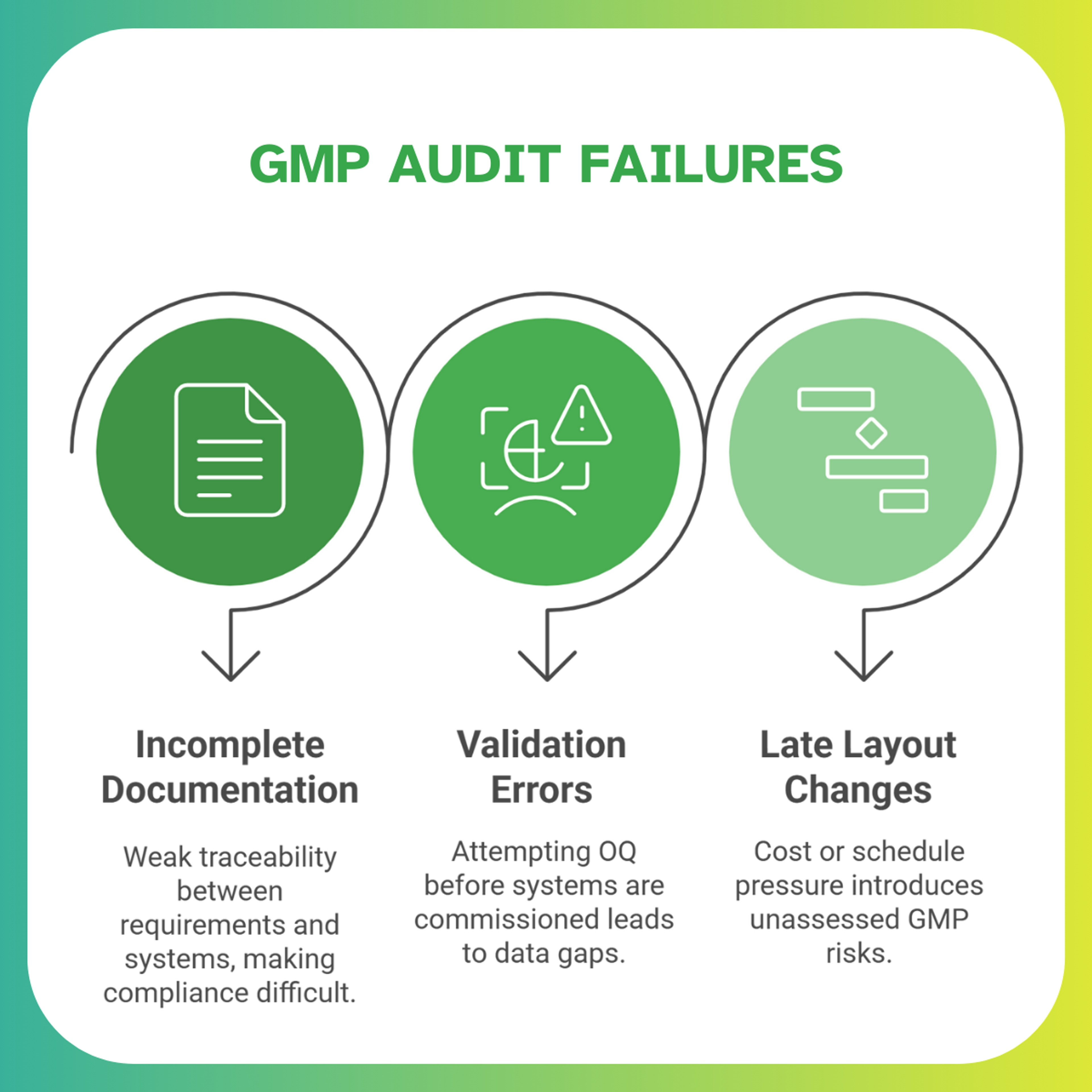
Recurring issues include:
- Incomplete or inconsistent design documentation, weakening traceability between GMP requirements and installed systems, and making compliance difficult to justify. during inspections
- Validation sequencing errors, such as attempting OQ before systems are fully commissioned or utilities are stabilized, lead to data gaps flagged by inspectors.
- Late-stage layout changes driven by cost or schedule pressure, introducing unassessed GMP risks and undermining previously approved design assumptions, resulting in repeat observations and extended remediation timelines.
What Makes Pharma Plant Construction in Uzbekistan Different
Pharma plant construction in Uzbekistan is shaped by a combination of rapid market expansion, strong localization policies, and rising foreign investment, while regulatory systems and supply chains are still maturing.
Key contextual differences include:
- Unlike India or Eastern Europe, Uzbekistan’s GMP ecosystem is still developing, which affects vendor maturity, validation practices, and inspection readiness
- Compared to MENA markets with established import-led GMP infrastructure, Uzbekistan projects face higher execution risk if GMP requirements are not met.
Regulatory Maturity vs Export-Driven GMP Expectations
Regulatory expectations diverge sharply once export ambitions are introduced.
Key realities include:
- Local regulatory approvals in Uzbekistan can often be achieved by meeting baseline national requirements
- Export-oriented facilities, however, must align fully with WHO GMP principles, immediately raising the compliance benchmark.
- WHO GMP requires documented risk-based design, lifecycle validation, and demonstrable control of critical quality attributes, exceeding many local minimum standards
- Facilities designed only for local approvals frequently encounter redesign, revalidation, or delayed export registrations when WHO GMP alignment is assessed later.
Infrastructure Readiness & Utilities Reality
On-ground infrastructure readiness varies significantly across regions, directly impacting GMP execution. Critical considerations include:
1. Power reliability, incoming water quality, and the stability of WFI and clean steam systems differ by location
2. GMP facilities must therefore incorporate:
- Redundancy in power supply
- Robust water treatment trains
- Continuous monitoring to maintain validated conditions
3.HVAC performance is particularly sensitive to local utilities and maintenance capability, making early engineering design and qualification planning essential for sustained compliance
Import Dependency for Critical GMP Systems
A high level of import dependency shapes project timelines and risk profiles.
Key implications include:
Many GMP-critical systems in Uzbekistan are imported due to limited local manufacturing capacity, including:
- AHUs
- Cleanroom panels
- Process automation platforms
- Validation instruments
This dependency introduces:
- Lead-time risk
- Customs clearance complexity
- Coordination challenges across multiple vendors and countries
Without early procurement planning and aligned qualification strategies, these dependencies can directly delay construction completion and GMP readiness.
Step-by-Step Framework for GMP facility design and construction in Uzbekistan
A compliance-first delivery model reduces rework by tying user requirements, design decisions, and qualification evidence into one lifecycle traceability chain. The practical expectation is “fitness for intended use” proven through controlled documentation, managed changes, and staged verification—not a last-minute inspection scramble.
Concept & GMP Master Planning
Concept master planning should lock in GMP zoning, a contamination-control strategy, and scalable adjacencies so that future capacity expansion does not disrupt segregation or flows.Early URS-level clarity (what the plant must consistently achieve) supports downstream design qualification and keeps engineering choices aligned to quality risk.
Where GMP Must Be Designed In
Room classification logic, pressure cascade concepts, and core flow paths (materials, waste, personnel) are “hard-to-reverse” once civil works and key penetrations are fixed.Major utility architecture (generation, storage, distribution, routing, access for maintenance) also becomes structurally constrained after build, making late GMP fixes expensive and disruptive.
Detailed Design & Engineering
Detailed design must convert the URS into coordinated IFC packages that cover HVAC control intent, cleanroom details (finishes, joints, penetrations), and utility schematics, all of which are qualification-ready.Documentation alignment matters here: drawings, specs, and control narratives should support design review and provide clear testable acceptance criteria for CQV.
Construction & Installation Phase
Construction execution should be managed under strict engineering change management so that any deviation affecting direct-impact systems is assessed, approved, and fully traceable.Multi-vendor coordination must protect GMP-critical interfaces (HVAC controls, cleanroom envelope integrity, utility loop tie-ins) through routine quality oversight and issue-closure discipline.
CQV: From IQ/OQ to Inspection Readiness
Inspection readiness depends on sequencing CQV, so commissioning establishes stable operation before IQ/OQ evidence is captured, avoiding gaps and repeated tests. Expected documentation typically includes a validation master plan, approved protocols/reports, specifications, risk assessments, training and calibration records, and controlled SOPs that demonstrate ongoing control.
Handover, Audit Support & Go-Live
Handover should provide a complete, reviewable package: as-builts, turnover dossiers, executed IQ/OQ/PQ records (as applicable), and a clear story from URS to “fit for use.”During inspection support, disciplined document control and rapid, evidence-based responses to observations protect the go-live timeline and reduce the risk of conditional approvals.
Selecting the Right Pharmaceutical Project Management Services Partner
Choosing the right pharmaceutical project management services partner is a risk decision, not a procurement exercise.
The partner must be capable of owning GMP execution end-to-end, with clear accountability for compliance outcomes across:
- Design
- Construction
- Validation
- Handover
What to Expect From a GMP-Focused PMC/EPCM
A GMP-focused PMC/EPCM should deliver compliance-led project governance, where GMP requirements drive decisions rather than cost or schedule alone.
Key expectations include:
- Leading GMP master planning from project inception
- Coordinating design reviews through a compliance lens, not just constructability
- Embedding change control discipline across engineering and construction phases
- Actively coordinating CQV planning alongside design and construction, ensuring validation is not treated as a downstream activity.
- Maintaining structured, audit-ready documentation throughout the project lifecycle to ensure inspection readiness without last-minute remediation
Managing Multi-Vendor, Multi-Country GMP Projects
For projects involving global suppliers and specialized GMP systems, effective coordination becomes critical.
The PMC/EPCM must provide:
- Centralized control over specifications, interfaces, and documentation
- Alignment of vendor deliverables to approved GMP requirements
- Active management of cross-country procurement timelines
- Consistent qualification standards across all systems
Strong coordination among HVAC, cleanroom, utility, and automation vendors reduces integration risks and prevents documentation gaps that commonly lead to audit observations.
Inotek: Your Strategic Partner in Building GMP-Compliant Pharma Facilities in Uzbekistan
Building a GMP-compliant pharmaceutical manufacturing facility in Uzbekistan involves more than meeting local approval requirements. Manufacturers must navigate evolving regulations, infrastructure constraints, import-dependent GMP systems, and WHO-aligned export expectations—all while controlling timelines and compliance risk. This is where Inotek steps in as a strategic execution partner.
We do not treat GMP as a checklist to be completed at the end of the project. We engineer compliance into facility planning, design, construction, and validation—aligned with WHO GMP and globally accepted regulatory practices followed by FDA, EMA, and CDSCO.
Our comprehensive approach includes:
- GMP-Led Greenfield & Expansion Planning: Compliance-first master planning, zoning, and layout strategies designed to meet WHO GMP expectations from Day 1 and support future capacity expansion.
- End-to-End Pharmaceutical Project Management Services: Integrated PMC/EPCM oversight across engineering, procurement, construction, and CQV to preserve GMP intent throughout execution.
- CQV & Inspection Readiness Management: Structured validation planning, documentation control, and audit support to enable show-cause readiness for WHO GMP and export inspections.
- Multi-Vendor & Cross-Border Coordination: Centralized control of imported GMP systems, global suppliers, and qualification documentation to minimize interface risks and schedule delays.
By partnering with Inotek, pharma manufacturers have achieved:
- Faster stabilization and commissioning of GMP-ready greenfield facilities
- Reduced compliance gaps and lower inspection-stage remediation effort
- Predictable timelines despite import dependencies and infrastructure constraints
While local market access is important, facilities in Uzbekistan increasingly need to support exports and international registrations. Successful GMP facility delivery must therefore address lifecycle compliance, operational resilience, and audit repeatability. At Inotek, facilities are designed not just to pass the first inspection, but to remain compliant through scale-up, product additions, and regulatory scrutiny over time.
Recognized among the Top 10 Pharma Turnkey Contractors & Project Consultants in 2022 & 2025, Inotek supports pharma leaders in designing, building, and upgrading GMP-compliant facilities across emerging and regulated markets.
📞 Connect with our experts or visit www.inotek.co.in to schedule a consultation with Mr. Rohit Ochaney.
Whether you are planning a greenfield pharma manufacturing facility in Uzbekistan or strengthening GMP compliance for exports, Inotek ensures your project is compliant, resilient, and future-ready.
FAQs
What GMP standards should pharma facilities in Uzbekistan be designed to meet?
Pharma facilities in Uzbekistan should be designed to meet WHO GMP standards as the baseline, especially for export-oriented manufacturing. While local approvals may suffice for domestic supply, WHO GMP alignment ensures inspection readiness for international markets and reduces the risk of costly redesigns or repeat audits later.
Why is GMP compliance critical for greenfield pharma manufacturing in Uzbekistan?
GMP compliance is critical for greenfield projects because early design decisions directly affect audit outcomes. Layout zoning, HVAC concepts, utilities design, and material flow cannot be easily corrected after construction. Designing for GMP from Day 1 helps avoid validation failures, inspection delays, and long-term compliance limitations.
What are the most common GMP risks during pharma plant construction in Uzbekistan?
Common risks include incomplete GMP master planning, late-stage design changes, dependency on imported GMP systems, and poor coordination between construction and validation teams. These issues often lead to documentation gaps, delayed qualification, and inspection observations that extend project timelines.
How long does it typically take to build a GMP-compliant pharma facility in Uzbekistan?
A GMP-compliant greenfield pharma facility in Uzbekistan typically takes 18–30 months, depending on plant scale, import dependency for critical systems, and the scope of validation. Aggressive timelines without GMP-led planning often increase compliance risk and delay commercial production.
More blogs
Related reading
8 Regulatory Decisions Before CGT Engineering Freeze
Dead Legs in Pharma Utilities: Why CAPA Cannot Fix Poor Design