U.S. Tariff Impact on Pharma Facility Design: EPCM Strategies for Compliance and Speed
August 20, 2025
U.S. Pharma Tariffs: Compliance, QA, and Facility Design Challenges
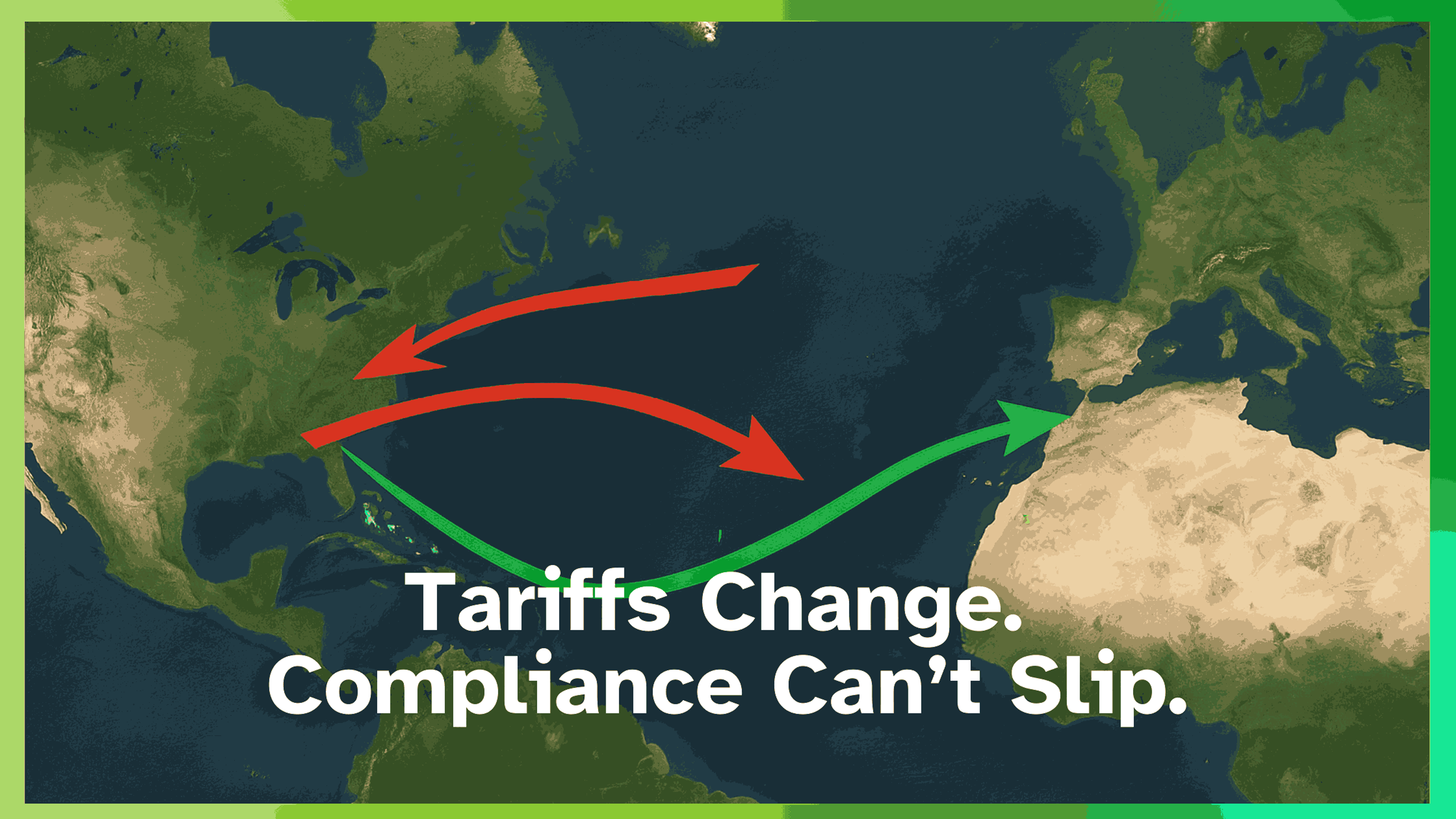
Pharma supply chains are at a critical crossroads. The new U.S.–EU trade deal imposes a 15% tariff on pharmaceutical imports, explicitly covering finished medicines and, potentially, active pharmaceutical ingredients (APIs) under the ongoing Section 232 review (Pharmaceutical Technology; Reuters). This escalation transforms tariffs from a political lever into a compliance mandate, forcing companies to act within compressed 12–18 month windows. For pharma manufacturers, this means rethinking supply chain localisation, GMP compliance, and inspection readiness. For EPCM partners like Inotek, it marks a redesign moment — driving urgent shifts in pharma facility design, CQV execution, and audit-proof validation to meet both FDA and Annex 1 standards.
💡 Execution Insight: Treat the 15% tariff as the new baseline. Waiting for clarity risks lost time, supply disruption, and compliance gaps.
Tariff Impact on Pharma Supply Chains: Beyond Politics to Compliance
This is not just another round of political posturing. The new U.S.–EU trade framework explicitly names pharmaceuticals under a 15% duty. Analysts estimate that, if applied broadly, the tariff could add $13–$19 billion in costs to branded medicines imported into the U.S.
The complexity deepens with the ongoing Section 232 review, which could extend tariffs to active pharmaceutical ingredients (APIs) or generic medicines. Companies are expected to adjust pharma supply chains and facility design within just 12–18 months before penalties take effect.
Tariff Impact on Pharma Stakeholders: Finance, QA, and Regulatory Affairs
- Finance & Commercial: Prepare for higher COGS, margin compression, and pricing pressure.
- QA & CQV: Site or supplier switches will trigger regulatory inspections and require defensible documentation.
- Regulatory Affairs: Expect changes in serialisation and packaging artwork for U.S.-specific compliance.
EPCM Partner Response: Facility Retrofits, Tech Transfer, and Compliance Readiness
- Compressed Timelines: Facility retrofits and tech transfers must align to a <18-month execution window.
- Vendor Constraints: HVAC, cleanroom, and filtration suppliers will face long-lead bottlenecks — pre-qualify early.
- Design Traceability: Ensure FDA + Annex 1 compliance is built into every step from URS → design → CQV.
💡 Execution Insight: Treat the 15% tariff as the base case. Build contingency plans for broader tariff coverage under Section 232. Waiting for clarity is a strategic risk — by the time rules are finalised, execution windows may already be closed.
Pharma Tariffs as a National Security Mandate: Localisation and Inspection Readiness
The U.S. Commerce Department has now defined pharma supply chains as a national security issue. Commerce Secretary Howard Lutnick stated that “Americans have been reliant on foreign supply of key pharmaceutical products for decades, and the new tariffs aim to end this structural weakness”.
Localisation, Traceability, and Speed: Practical Facility Design Shifts
- Localisation is no longer optional – moving production closer to the U.S. is becoming a regulatory expectation, not just a cost decision.
- Design traceability is critical – every URS → design → CQV step must be fully documented to withstand both FDA and Annex 1 inspections.
- Speed is strategic – with tariff enforcement windows tightening, facilities must be designed, retrofitted, and validated on compressed timelines.
💡 Execution Insight: Treat localisation not as a “business advantage” but as a compliance mandate. Designs that cannot defend dual-inspectorate scrutiny or meet accelerated CQV schedules will fail under the new regime.
Pharma Import Dependency: Why Localisation is Now a Compliance Priority
The U.S. still imports 75% of essential medicines. India supplies nearly 50% of generics, while China provides around 80% of APIs. This heavy reliance is now under direct political and economic attack, putting both supply continuity and compliance at risk.
Resilience, Dual-Sourcing, and Audit-Ready Design Under Tariff Pressure
- Resilience-first design – facilities must be built with localisation pathways to withstand tariff shocks.
- Dual-sourcing strategies – avoid single-country dependencies by qualifying multiple vendors across cleanroom, HVAC, and critical utilities.
- Audit-ready execution – supplier/site switches, HVAC zoning changes, and serialisation updates will face intensified FDA + EU inspection scrutiny.
💡 Execution Insight: Dependency on offshore APIs and generics is no longer just a supply-chain concern- it is now a compliance and inspection risk that must be engineered out of facility design.
How U.S. Tariffs Reshape Pharma Facility Design and Execution
The tariff environment is reshaping how pharma facilities are planned, built, and validated. Both pharma companies and EPCM partners now face compressed timelines, localisation mandates, and dual FDA–Annex 1 scrutiny that will define the next generation of facility design.
For Pharma Companies
- Tighter Timelines: Expansion or relocation must fit within 12–18-month tariff grace periods.
- Budget for Localisation: The 15% pharma duty eliminates offshore cost arbitrage, making local builds a financial necessity.
- Reassess Supply Networks: Reliance on offshore APIs or branded imports is no longer just an operational risk — it is now a compliance and profitability liability.
For EPC/EPCM Partners
- Inspection Readiness: Facilities must be engineered to pass FDA + Annex 1 dual inspections without costly retrofit gaps.
- Flexibility: Modular and scalable facility designs provide resilience against shifting trade and compliance pressures.
- Speed of Delivery: Execution pace is no longer negotiable — delays directly translate into financial and compliance losses.
💡 Execution Insight: Successful pharma facility design under tariff pressure requires speed, modularity, and audit defensibility. Firms that fail to integrate localisation and regulatory readiness from day one risk both market access and profitability.
Pharma Tariff Playbook: Function-Wise Actions for QA, CQV, RA, and EPCM
Tariff shifts don’t impact every function equally. Here’s a role-wise playbook outlining how QA, CQV, RA, and EPCM teams can align controls, mitigate risks, and maintain compliance while safeguarding project timelines.
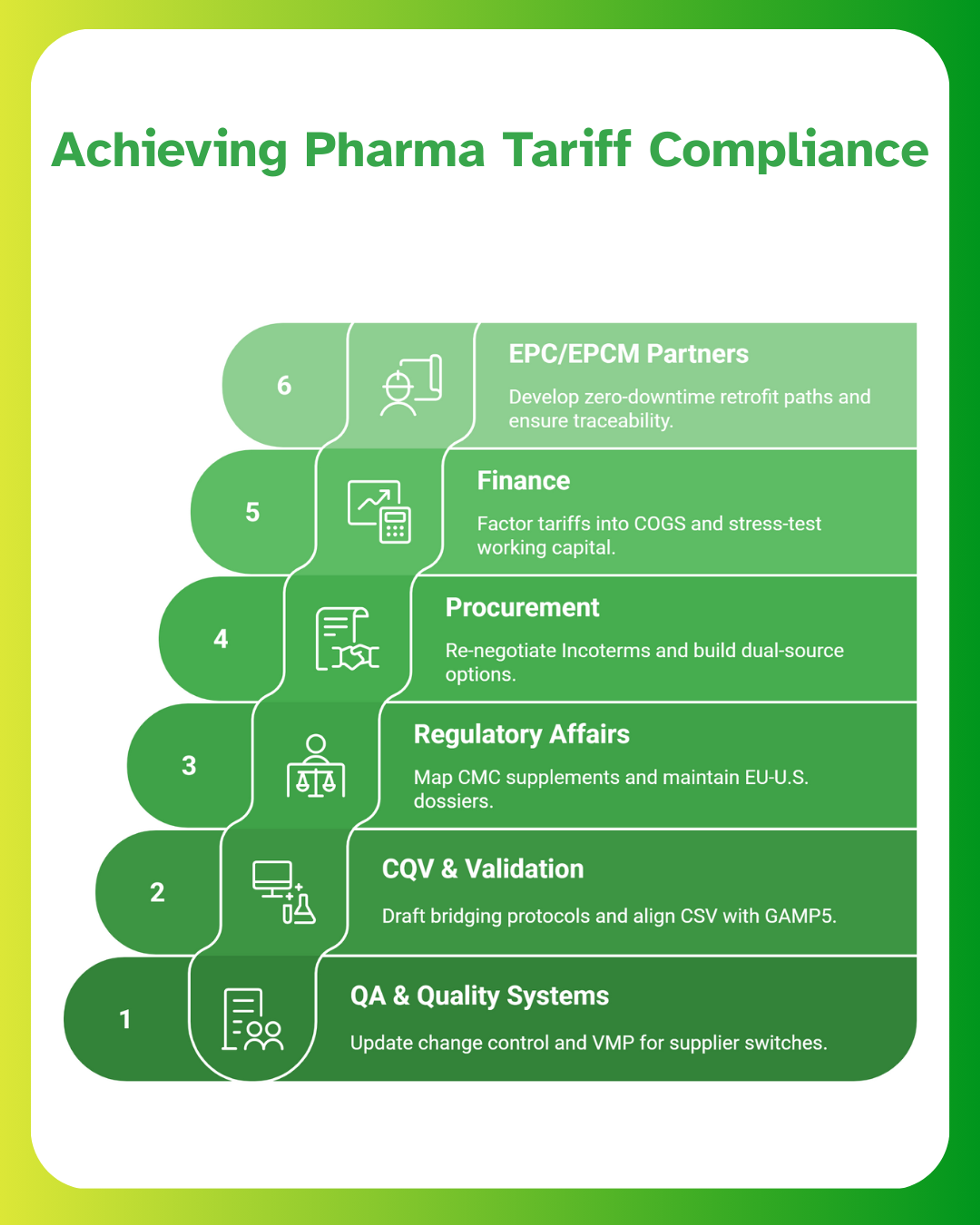
💡 Execution Insight: A pharma facility design that is not inspection-ready, modular, and speed-driven will fail under the tariff enforcement timeline. This playbook gives every function — from QA to EPCM — a structured path to stay compliant and operational.
Pharma Facility Strategy: Retrofit vs Rebuild Under U.S. Tariff Pressure
Tariff-driven localisation forces companies to decide: retrofit existing pharma facilities or build new capacity. Each path carries trade-offs in speed, cost, and inspection readiness, making the right choice critical for staying compliant under the 15% tariff mandate.
Live-Site Retrofits (Speed Hedge):
Retrofits allow companies to segment existing facilities by airlocks and utilities, phasing HVAC cutovers and qualifying areas one by one. This approach protects ongoing supply while adding capacity, enabling immediate localisation at a lower upfront cost. For firms that cannot afford production downtime, retrofits provide a faster path to U.S. capacity without halting existing operations.
Greenfield or Brownfield Builds (Sterile Uplift):
For long-term sterile operations, new builds offer future-proof compliance. By integrating unidirectional personnel and material flows, RABS/isolators, and gowning logistics from day one, these facilities ensure sterility and scalability. They also embed environmental monitoring readiness (HEPA integrity, recovery rates, smoke studies) upfront, aligning fully with FDA and Annex 1 requirements. While slower to execute, greenfield builds deliver higher GMP defensibility and modular expansion potential.
Siting Strategy (Risk Reduction):
Location is equally critical. Companies should prioritise regions offering permitting incentives, redundant utilities, and skilled pharma labour pools. This not only accelerates project approvals but also reduces operational risks and training delays, strengthening workforce resilience.
💡 Execution Insight: Retrofit when speed is paramount. Rebuild when sterility, scalability, and long-term compliance are non-negotiable. The most resilient pharma manufacturers run both tracks in parallel — hedging against tariff uncertainty while staying inspection-ready.
Tech Transfer Under Tariffs: Meeting 12–18 Month Compliance Windows
When tariffs compress relocation timelines to 12–18 months, pharma tech transfer becomes a race against inspection deadlines. Execution must be precise, defensible, and digitally backed to avoid regulatory pushback and supply disruption.
Defensible Tech Transfer Flow: From MCB to PPQ Under Regulatory Scrutiny
To safeguard data integrity and inspection readiness, maintain the full transfer sequence:
- MCB → Comparability → Engineering Runs → PPQ — never skip or compress steps.
- Lock CPPs & CQAs early to avoid protocol rewrites and inspection delays.
- Align cleaning validation across facilities so auditors cannot challenge comparability.
- Secure raw material equivalence by pre-validating supplier changes to block FDA/EU rejections.
Digital Pharma Facility Backbone: MES, eBMR, and GAMP5 Validation
- Update MES/eBMR systems in parallel with transfer planning.
- Validate using GAMP5 CSV, ensuring test evidence can withstand data integrity deep-dives.
- Enable electronic traceability across all batches — facilities must be “audit-proof from day one.”
Avoiding Pitfalls: Governance Clarity vs Scheduling Gaps in Tech Transfer
If PPQ is delayed due to late URS sign-offs, the issue is governance, not scheduling. No project timeline tool can compensate for design indecision — clarity at the start determines compliance success.
💡 Execution Insight: Treat tech transfer as both a compliance sprint and a supply continuity safeguard. The true schedule enablers are governance clarity and digital validation readiness.
Audit-Proof Pharma Facilities: Designing for Dual FDA + EU Compliance
Tariff-driven localisation will trigger dual inspections — FDA and EU. To survive this scrutiny, pharma facilities must be engineered and validated so that one evidence trail satisfies both inspectorates. This approach not only reduces duplication but also accelerates readiness.
Contamination Control Strategy (CCS): FDA + Annex 1 Alignment
- Use the same scientific basis for FDA and Annex 1 compliance.
- Document assumptions, contamination vectors, and mitigations consistently to align inspection narratives.
Aseptic Facility Qualification: HEPA, ISO 14644, and Annex 1 Standards
- Validate HEPA integrity, recovery rates, smoke studies, and ISO 14644 classifications as baseline acceptance criteria.
- Define once, prove twice — a single dataset must withstand FDA and EU inspection review.
Computerised Systems Validation (CSV) and Backup Resilience in Pharma Facilities
- Classify computerised systems correctly at the outset.
- Run restore drills during PQ to demonstrate resilience — don’t leave recovery plans buried in IT SOPs.
💡 Execution Insight: Dual compliance isn’t about doubling work — it’s about designing one defensible evidence trail that meets both FDA and EU inspectorate standards without rework.
EPCM Partners in Pharma Facility Design: Inotek’s Role in Compliance and Resilience
EPC partners play a critical role in translating tariff-driven compliance pressure into inspection-ready, on-time facilities. Their value lies not in construction speed alone, but in engineering defensibility, live-site execution, and schedule assurance — all of which are essential under the 15% tariff mandate.
Design Defensibility: Building URS → Design → CQV Traceability
- Build URS → Design → CQV traceability into every project from the start.
- Ensure no documentation gaps that FDA or Annex 1 inspectors could exploit.
Live-Site Retrofits: Zero-Disruption Execution Under Tariff Pressure
- Use zero-downtime phasing to keep production running.
- Tie punch-list closure directly to CQV gates so validation stays on track.
Sterile Suite Readiness: Airflow, Gowning, and Isolator Integration
- Plan airflow visualisation, gowning logistics, and isolator integration upfront.
- Ensure environmental monitoring readiness from launch — not as an afterthought.
Schedule Control and Vendor Readiness: Staying Ahead of Tariff Timelines
- Maintain long-lead registers to lock equipment timelines early.
- Pre-qualify vendors to avoid procurement delays.
- Run risk burn-down tracking that shows measurable exposure reduction — not just Gantt chart updates.
💡 Execution Insight: EPC delivery is not about pouring concrete faster. It is about designing for compliance, executing without downtime, and proving readiness to inspectors on day one.
Inotek: Your EPCM Partner in Pharma Facility Design, Compliance, and Tariff Readiness
The 15% U.S. tariffs on pharmaceutical imports have transformed facility planning from a commercial choice into a compliance mandate. Pharma companies now face compressed timelines, localisation pressures, and dual FDA–Annex 1 scrutiny. This shift — from tariffs to compliance to facility design transformation — demands specialised expertise and execution.
This is where Inotek steps in as your strategic EPCM partner.
We don’t just build facilities; we engineer inspection-ready, localised, and tariff-resilient pharma facility designs into every project—aligned with global regulatory standards such as FDA, EMA, Annex 1, ISO 14644, and CDSCO.
Our comprehensive approach includes:
- Design Defensibility: Building URS → Design → CQV traceability from the start, ensuring FDA + Annex 1 readiness.
- Zero-Downtime Retrofits: Executing live-site upgrades without disrupting supply continuity.
- Sterile Suite Engineering: Integrating airflow, gowning logistics, and isolator systems upfront for compliance and sterility.
- Schedule Control & Vendor Readiness: Pre-qualifying suppliers, managing long-lead equipment, and using risk burn-down tracking to stay ahead of delays.
By partnering with Inotek, pharma manufacturers have achieved:
- Faster facility commissioning timelines despite 12–18 month tariff windows.
- Reduced regulatory gaps and CAPAs through defensible CQV execution.
- Future-ready GMP facilities that balance compliance, resilience, and localisatin.
While compliance forms the foundation, successful pharma facility design under tariffs must also address broader industry expectations around:
- Environmental sustainability in HVAC and energy systems.
- Supply chain resilience through localisation and dual sourcing
- Data integrity and digital compliance via GAMP5 CSV and MES integration.
At Inotek, we ensure your facilities aren’t just audit-ready, but engineered for long-term operational excellence.
Recognised among the Top 10 Pharma Turnkey Contractors & Project Consultants in 2022 & 2025, Inotek helps pharma leaders design, retrofit, and expand facilities that meet the strictest GMP and sustainability standards.
📞 Connect with our experts today or visit www.inotek.co.in to schedule a consultation with Mr. Rohit Ochaney.
Whether you’re planning a greenfield facility or optimising an existing site, Inotek ensures your project is compliant, resilient, and future-proof.
FAQs
How are U.S. tariffs impacting pharma facility design?
U.S. tariffs are driving a shift toward localised pharma facility design, forcing companies to retrofit or rebuild plants under compressed 12–18 month timelines while meeting FDA and Annex 1 compliance.
What does Section 232 mean for pharma supply chains?
The ongoing Section 232 review could expand tariffs to APIs and generics, adding further pressure on supply chain resilience and EPCM-led localisation projects.
Should pharma companies retrofit or rebuild facilities under tariff pressure?
Retrofits help achieve faster capacity uplift, while greenfield builds future-proof sterile operations. Many firms pursue both strategies in parallel to balance speed and compliance.
How can EPCM partners like Inotek help with tariff-driven compliance?
Inotek integrates URS → Design → CQV traceability, delivers zero-downtime retrofits, ensures sterile suite readiness, and manages vendor bottlenecks to keep projects compliant and on schedule.
What execution insights should pharma leaders prioritise under tariffs?
Leaders should plan against a 15% tariff as the base case, accelerate tech transfer and localisation, and ensure facilities are audit-proof by design to withstand dual FDA/EU scrutiny.
More blogs
Related reading
8 Regulatory Decisions Before CGT Engineering Freeze

Dead Legs in Pharma Utilities: Why CAPA Cannot Fix Poor Design