8 Regulatory Decisions Before CGT Engineering Freeze
What must be resolved before CGT facility engineering freeze? Examine closed processing, segregation, cleanrooms, CCS, cryogenic risk, utilities, QMS and validation.
October 01, 2026
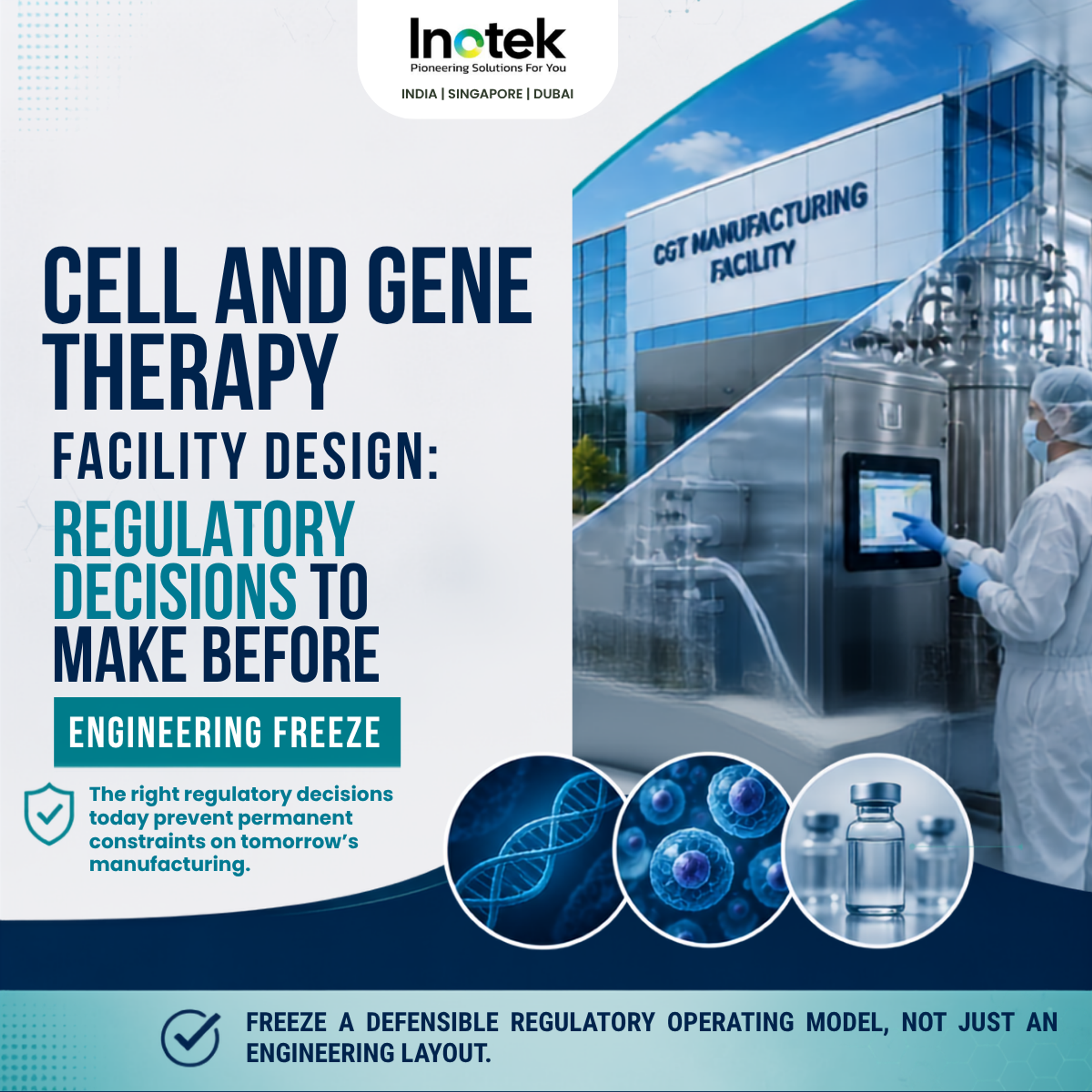
Cell and gene therapy facilities are often engineered while the manufacturing process is still moving.
Manual manipulations become automated. A nominally open transfer becomes a sterile connection. Patient concurrency increases. A second product introduces a different vector or containment profile. Yet cleanroom classifications, HVAC architecture, room adjacencies, segregation barriers, transfer routes, and cryogenic systems may already be frozen around an earlier process assumption.
That is the strategic risk of engineering freeze in CGT: a process assumption that was reasonable during development can become a permanent constraint on commercial manufacturing.
For senior management, engineering freeze should therefore be treated as a regulatory design-control gate. Before approving it, the organisation should know which product and process risks the facility is designed to control, where those risks are being controlled, what operating restrictions result, and what evidence will eventually demonstrate that the strategy works.
The regulatory frameworks themselves make this important. The European Commission has a dedicated GMP guideline for Advanced Therapy Medicinal Products (ATMPs), while FDA's May 2026 guidance continues a flexible, science- and risk-based CMC approach for cellular and gene therapy products. In both cases, flexibility increases the importance of a product- and process-specific rationale rather than reducing it.
What Must Be Decided Before Engineering Freeze in a CGT Facility?
Before detailed engineering becomes commercially difficult to reverse, a CGT facility should have a defensible position on process exposure, open versus closed processing, segregation and concurrency, environmental control, personnel and material movement, contamination control, cryogenic resilience, critical utilities, QMS consequences and validation strategy.
These decisions should form one control architecture. If an operation is considered closed, that conclusion may support a different environmental strategy; the environmental strategy influences HVAC and monitoring; closure increases dependence on connection integrity and single-use controls; and those claims ultimately need qualification or validation evidence.
Inotek's CGT Freeze-Readiness Chain captures this relationship:
Process Risk → Control Strategy → Facility Consequence → Operating Constraint → QMS Obligation → Validation Evidence
A facility is not regulatorily mature when these links are being resolved independently.
1. Define the Regulatory Operating Envelope Before Designing for Flexibility
The facility will usually outlive the process version the concept design was based on. The challenge is therefore not to predict every future manufacturing change, but to determine which changes the facility can absorb without reopening its fundamental contamination-control or segregation argument.
A “flexible facility” needs defined regulatory boundaries
For an autologous cell therapy operation, the design envelope may need to consider peak patient concurrency, open manipulations, incubator loading, operator interventions, patient-specific staging and likely automation. A gene therapy or multi-product facility may need additional boundaries around viral-vector handling, containment, waste, cleaning and future portfolio introduction.
This distinction changes how flexibility should be discussed at investment level. Another processing unit may physically fit inside a room, but that does not mean another process can operate there under the existing environmental, segregation or qualification strategy.
FDA's current CGT CMC framework explicitly recognises manufacturing complexity and limited process knowledge and provides for science- and risk-based flexibility during development. FDA's separate manufacturing-change guidance also reflects the importance of assessing how changes affect product comparability.
For CGT, regulatory adaptability is a better measure of facility flexibility than unused floor area.
2. Treat Open Versus Closed Processing as a Facility Architecture Decision
“Closed processing” can influence some of the largest CAPEX and lifecycle decisions in the facility. It should therefore never remain a high-level label on the process flow diagram.
Closure has to be established at the intervention level
Sampling, reagent addition, sterile connections, disconnections, harvest, filtration, product transfer and abnormal equipment interventions should be examined individually. EU ATMP GMP specifically links closed processing to environmental strategy and makes the nature of aseptic connections relevant to whether the system can remain closed.
That creates a direct design dependency. If an operation assumed to be closed later requires an uncontrolled or open intervention, the impact may extend into room classification, HVAC, monitoring, gowning, operator qualification and aseptic-process-simulation strategy.
Closed processing transfers risk rather than eliminating it
A genuinely closed process may reduce dependence on the surrounding environment, but it requires greater assurance from sterile connections, single-use assemblies, system integrity, operator practices, and supplier controls.
The economic benefit of closed processing should therefore be evaluated together with the controls needed to sustain the closure claim throughout routine and credible abnormal operations.
3. Use Segregation Strategy to Define GMP-Operable Capacity
Segregation is not simply a question of whether two products should share a room. It determines how much of the installed facility can operate concurrently.
Physical, temporal and technical segregation create different businesses
Permanent physical segregation can simplify some contamination controls but create under-utilised capacity islands. Temporal segregation can preserve asset flexibility while increasing dependence on scheduling, cleaning and line clearance. Closed or contained processing may enable greater concurrency, but only where the system boundary and contamination-control rationale support it.
Installed capacity is not the same as GMP-operable capacity
A plant may contain eight manufacturing positions yet be capable of using only five concurrently because of shared equipment, product segregation, patient-identity controls, waste movement, or personnel restrictions.
For investment decisions, GMP-operable capacity is the more meaningful number: the number of batches or patient products that can operate simultaneously while the approved contamination, segregation, identity and flow controls remain intact.
If that calculation is performed only after commissioning, the project may discover that its validated manufacturing capacity is materially lower than the capacity assumed in the business case.
4. Derive Cleanroom Strategy From Exposure and Contamination Risk
Cleanroom classification often enters engineering early because HVAC design needs a stable basis. Regulatory logic should run in the opposite direction: first establish how the product is protected, then determine the environmental conditions required to support that protection.
Product exposure should determine environmental dependency
Duration of exposure, operator proximity, aseptic manipulations, barrier technologies, closure integrity and credible interventions all influence how strongly the process depends on its surrounding environment.
Over-classification is not automatically safer design. It can create a permanent burden in HVAC energy, gowning, environmental monitoring, cleaning, maintenance and requalification. Under-classification creates the more obvious contamination risk.
The correct objective is the least complex environmental architecture that remains scientifically defensible for the actual process.
5. Make the Contamination-Control Strategy a Design Input
A contamination-control strategy developed after facility design can explain the design. It cannot meaningfully challenge it.
The CCS should show where risk moves
When a closed system reduces environmental dependency, risk moves toward system integrity and connections. When temporal segregation replaces dedicated rooms, risk shifts to scheduling, clearance, and cleaning. When shared equipment improves utilisation, cleaning and identity controls become more consequential.
This is where the CCS adds strategic value: it exposes whether an engineering optimisation has genuinely reduced overall contamination risk or simply transferred it into a procedural or supplier dependency that has not yet been designed with equivalent rigour.
For leadership, the CCS should therefore arbitrate design decisions across process development, engineering, manufacturing, QA, and validation, not simply be prepared as a compliance document before inspection.
6. In Autologous Manufacturing, Flow Is Part of Chain of Identity
In patient-specific manufacturing, the physical facility participates in product identity control.
Peak and abnormal flows matter more than ideal diagrams
A delayed patient batch, an occupied incubator, QC sampling, waste removal, emergency maintenance or an unplanned cryogenic transfer can create movements not visible in a routine process-flow drawing.
At low clinical throughput, experienced operators may compensate through manual oversight. At commercial scale, that dependency can become a systematic source of deviation, congestion and mix-up risk.
The practical implication is important: a facility can have sufficient equipment and room area but lack the flow resilience needed to use that capacity safely at commercial concurrency.
7. Assess Cryogenic Systems and Utilities by Concentration of Consequence
CGT facilities can place multiple patient products or irreplaceable biological materials behind a relatively small number of infrastructure dependencies.
Redundancy is not the same as independence
Two cryogenic units may share the same LN2 supply, alarm architecture, monitoring platform, electrical distribution or emergency-response pathway. A single common-mode failure can therefore defeat nominal redundancy.
Single-use manufacturing creates similar shifts in utility criticality. Removing CIP/SIP may reduce conventional process utilities while increasing dependence on electrical continuity, HVAC, process gases, incubators, controlled-temperature systems and monitoring platforms.
A better criticality sequence is:
Failure Mode → Process Impact → Patient/Product Consequence → Required Resilience
This is especially relevant for facilities being developed in Saudi Arabia and the wider GCC, where local GMP expectations must be mapped alongside intended EU or US market requirements. SFDA's current guidance library lists updated GMP Guidelines in May 2026, and its GMP framework includes specific ATMP provisions alongside the wider GMP system rather than treating advanced therapies as a generic sterile-product category.
8. Quantify the QMS and Validation Consequences Before Freeze
Engineering decisions continue generating cost long after CAPEX closes.
Every facility choice creates a QMS obligation
Shared suites create cleaning and identity controls. Temporal segregation creates scheduling and clearance requirements. Closed systems increase reliance on connector integrity, supplier qualification and change management. Higher cleanroom classifications increase environmental monitoring and requalification burden.
These consequences ultimately affect staffing, deviation volumes, investigation workload, batch-cycle time and cost of goods. The facility should therefore be assessed for QMS scalability, not merely for technical operability.
Validation should challenge the design while alternatives still exist
Before the engineering freeze, the project should already know how it can eventually demonstrate its material design claims. If lower environmental dependence relies on closure, system integrity must be testable. If concurrency relies on segregation, you must be able to challenge worst-case operating conditions. If cryogenic resilience is critical, backup, alarm and recovery performance require meaningful acceptance criteria.
Validation should confirm the design rationale, not become the stage at which that rationale is first discovered.
What Should Senior Management Expect at CGT Engineering Freeze?
A mature design-freeze package should allow leadership to trace the most consequential facility decisions across a common logic.
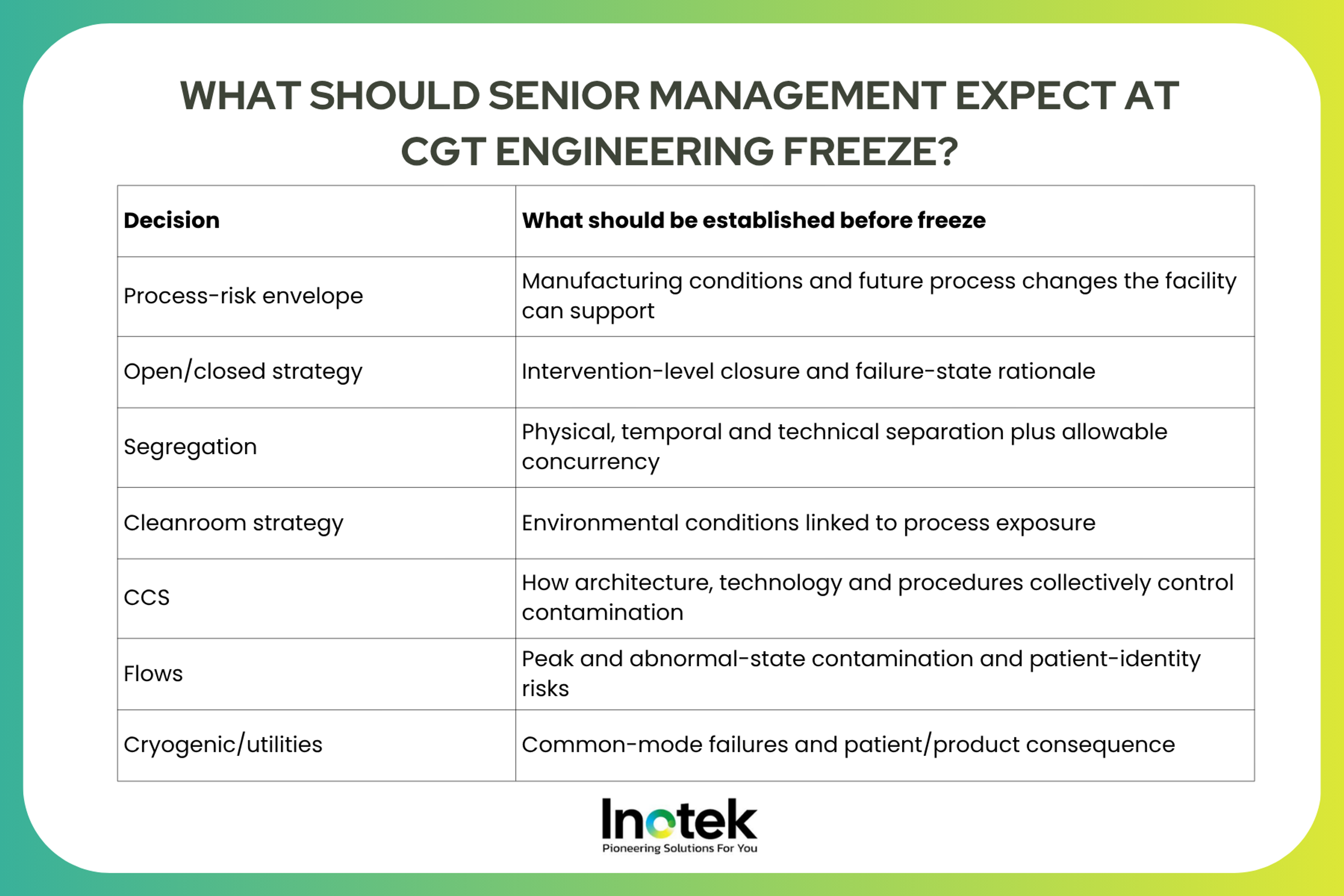
The objective is not more documentation. It is consistency. If process development calls an operation closed, engineering designs a lower environmental dependency around that claim, QA treats a connection as an open risk, and validation has no strategy for demonstrating system integrity, the project does not have four documentation issues. It has one unresolved regulatory design decision.
Engineering Freeze Should Preserve Regulatory Optionality
CGT facilities can be modified after design freeze, but changing the control philosophy becomes progressively more expensive once room classifications, equipment platforms, segregation barriers, HVAC systems and qualification strategies have been built around it.
The value of pre-freeze regulatory scrutiny is therefore not simply avoiding a future observation. It is preserving the organisation's ability to scale throughput, introduce future therapies, change manufacturing technology and operate across intended regulatory markets without repeatedly reopening the facility's fundamental design rationale.
For a senior sponsor, the real approval question is: is the organisation freezing a coordinated engineering design, or a regulatory operating model it is genuinely prepared to defend for the life of the asset?
Inotek Regulatory-First CGT Design Review
Inotek Technologies operates as a pure regulatory-first consulting house, independent of EPC execution, equipment supply and construction interests. Its role is to challenge the regulatory, engineering, QMS and validation assumptions behind the proposed facility while the organisation still has meaningful alternatives.
For cell and gene therapy projects approaching engineering freeze, Inotek can independently assess the process-risk envelope, closure and segregation philosophy, environmental strategy, contamination controls, flows, infrastructure resilience, QMS consequences and validation logic before those decisions become embedded in the asset.
The objective is not to add more rooms, systems or specifications. It is to establish whether the proposed facility is the correct physical expression of the product, process and regulatory strategy.
Engage Inotek for an independent regulatory-first CGT design review before engineering freeze converts unresolved process assumptions into long-term capacity, compliance and validation constraints.
Frequently Asked Questions
What Cleanroom Classification Is Required for Cell Therapy Manufacturing?
There is no single cleanroom classification that applies to every cell therapy manufacturing operation. The appropriate environment depends on product exposure, whether processing steps are open or closed, the type of aseptic manipulation, barrier technology and the contamination risks involved. Open aseptic operations generally require greater environmental protection, while a properly justified closed process may reduce dependence on higher-grade surrounding environments.
What Is the Difference Between Open and Closed Processing in Cell Therapy Manufacturing?
In an open process, the product may be exposed to the surrounding manufacturing environment during activities such as sampling, reagent addition or transfer. A closed process maintains separation between the product and the external environment through closed equipment, sterile connections or validated system boundaries. However, closure must be assessed for individual interventions rather than assumed for the entire process.
Can Closed Processing Reduce Cleanroom Requirements in a CGT Facility?
Yes, closed processing can potentially reduce dependence on highly classified cleanroom environments, but this must be supported by a scientifically justified contamination-control strategy. The closure claim needs to remain valid during connections, sampling, transfers and credible abnormal interventions. Any reduction in environmental controls also increases reliance on system integrity, sterile connections, single-use assemblies and supplier controls.
What GMP Requirements Apply to Cell and Gene Therapy Manufacturing Facilities?
CGT facilities must establish controls appropriate to the product, process and intended market. Key considerations include premises and equipment design, contamination prevention, aseptic processing, environmental control, material and personnel flows, segregation, qualification, validation, documentation and an effective quality management system. The EU also provides GMP guidance specifically adapted to Advanced Therapy Medicinal Products, while FDA applies a science- and risk-based CMC approach to CGT products.
Why Is Segregation Important in Cell and Gene Therapy Manufacturing?
Segregation helps control cross-contamination, product mix-ups and patient-identity risks when different products, vectors or patient batches share a facility. It may be achieved through physical separation, separation in time, contained or closed processing, or a combination of controls. The chosen strategy also affects how many manufacturing operations can safely run concurrently within the facility.
What Is a Contamination-Control Strategy in a CGT Facility?
A contamination-control strategy, or CCS, is the integrated rationale showing how facility design, process technology, environmental controls, cleaning, monitoring, personnel practices and procedural controls work together to prevent contamination. For CGT facilities, the CCS should also show where risk moves when a design decision changes—for example, when closed processing reduces environmental dependency but increases reliance on system and connection integrity.
How Does Autologous Cell Therapy Affect Facility Design?
Autologous manufacturing requires particularly strong chain-of-identity and flow controls because each manufacturing batch is linked to an individual patient. Facility design therefore needs to account for patient-specific staging, concurrent batches, incubator use, QC sampling, material movement, waste flows and abnormal events. A facility may have sufficient physical space but still lack the flow resilience required for safe commercial-scale concurrency.
What Should Be Finalised Before Engineering Freeze in a CGT Facility?
Before engineering freeze, the project should have a defensible position on the process-risk envelope, open versus closed processing, segregation and concurrency, cleanroom strategy, contamination control, personnel and material flows, cryogenic and utility resilience, QMS implications and validation strategy. These decisions should be connected because changing one assumption can alter HVAC, monitoring, operating restrictions, qualification and lifecycle compliance requirements.
More blogs